

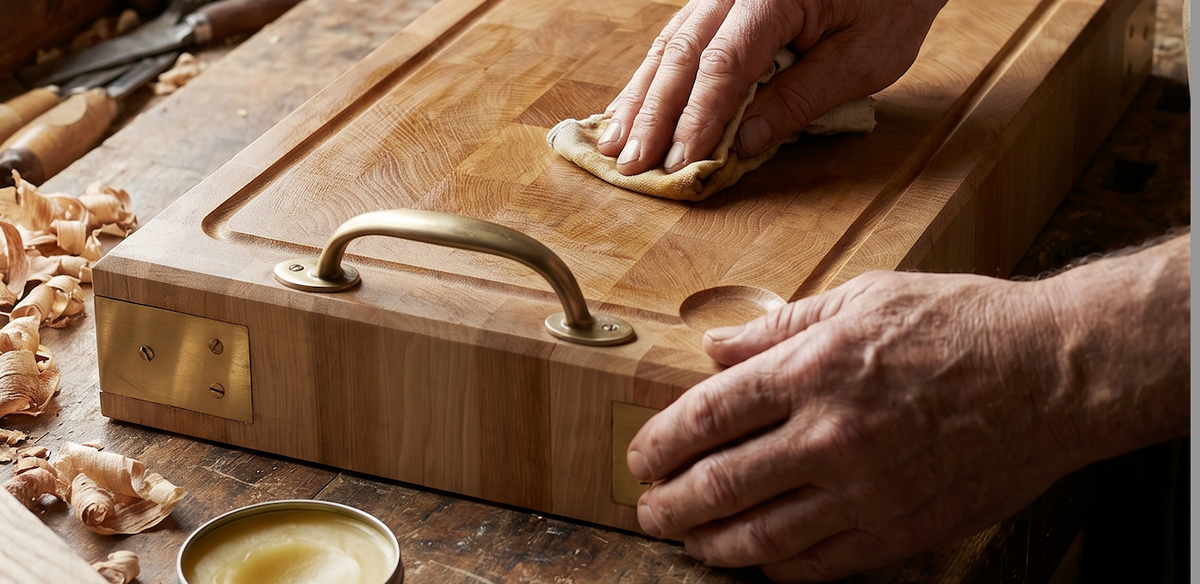
Regular maintenance for furniture that stands the test of time

Your end-grain butcher block and countertop
Your end-grain butcher block and countertop
End-grain wood is assembled with vertical fibers: the blade slides between the fibers, which then close back up. It is the gentlest surface for your knives, and the only one that is self-healing. It is also a living wood, delivered oiled and without a finish: it drinks, it breathes, it works. Therefore, it has two enemies—stagnant water and overly dry air.
DAILY USE:
Wash with warm soapy water, using a non-abrasive sponge, without soaking. The surface is washed—it is not soaked.
Dry immediately and completely with a dry dish towel. Then leave to air dry, never flat on a damp surface.
OIL ONCE A MONTH :
Use exclusively food-grade mineral oil: odorless and tasteless, it will never go rancid.
Clean and dry wood
Wash, then let dry for several hours. Oil does not penetrate damp wood: it traps the moisture inside.
Apply generously
Using a soft cloth, apply in the direction of the grain: to the surface, the edges, and the underside, so that the piece absorbs the oil evenly.
Let it penetrate
For several hours, ideally overnight. Add oil to areas that absorb it the fastest.
Wipe off the excess
With a dry cloth, until the wood is no longer greasy to the touch. A surface that remains oily will leave marks on food.
WHAT PERMANENTLY DAMAGES THE WOOD
The dishwasher and any immersion: swelling, followed by cracks and separation of the strips.
Stagnant water: dish rack, wet towel, puddle under the board.
Direct heat—hot dish, saucepan: it attacks the glue joints, and the damage cannot be repaired.
Very dry air or direct sunlight: radiator, heater, bay window.
Bleach and abrasive products: grayed wood, open fibers.
Your furniture — lacquered surfaces and varnished wood
Your furniture — lacquered surfaces and varnished wood
Your furniture has a film-forming finish: a water-based satin acrylic lacquer, or a varnish applied directly to the beech or oak. In both cases, what you are maintaining is not the wood itself — it is a film a few hundredths of a millimeter thick that protects it. All maintenance boils down to this: clean it without damaging it, and never try to buff it.
DAILY CARE — THREE STEPS
1-Dust
Regularly, using a soft, dry cloth or microfiber. Dust is abrasive: if wiped on a dry surface, it will eventually dull the film.
2-Clean
Use a microfiber cloth that is barely damp, with warm water and a drop of dish soap. Do not press down, and do not scrub in circular motions.
3- Dry
Immediately use a dry microfiber cloth. Prompt drying protects the edges and prevents water marks.
Never use polishing products on a satin lacquer. Multi-surface aerosols, waxes, polishes, or "shine restorers": they create shiny spots that cannot be fixed, and leave behind a greasy film that will make any future touch-ups impossible. A satin finish should be cleaned — it should not be buffed.
GOOD HABITS
Wipe up water splashes immediately, especially on the edges and around a basin: this is how water gets in.
Ventilate the bathroom after use, until the humidity returns to normal levels.
Use coasters and trivets on tabletops: heat and the damp bottom of a glass will leave marks on the film.
Move objects placed on the surface from time to time: a color difference will eventually develop underneath them.
Hardware items and metal parts
Hardware items and metal parts
Wipe regularly with dry cloths to prevent dust buildup. Use a specialized metal polish to maintain shine and prevent oxidation, ensuring your luxury hardware remains pristine.
Your marble countertop
Your marble countertop
Marble is a limestone: a noble, living material that develops a patina over time. It requires little maintenance, but two specific rules must be followed — a neutral soap, and zero acid.
DAILY CARE — THREE STEPS
Clean
Use a pH-neutral soap (special stone cleaner or mild dish soap) in lukewarm water, with a microfiber cloth or a non-abrasive sponge.
Rinse
With clear water, changing the water frequently: soap residue dulls the stone and leaves a grey film.
Dry
Immediately, with a soft cloth. Letting it air dry causes water spots, especially in areas with hard water.
Two different accidents, two different responses.
A stain is a liquid that has penetrated the stone: it can be removed. A dull mark — the whitish ring left by a glass of wine or lemon juice — is not a stain: it is the acid that has dissolved the surface. You do not clean it, you repolish it (see reverse). And in both cases: blot, do not wipe. A spilled liquid should be dabbed with a paper towel; wiping it spreads the stain and makes it larger.
GOOD HABITS
Coasters under all glasses, especially for wine, fruit juice, sodas, and alcohol.
A trivet under hot dishes, and a cutting board for food preparation.
In the bathroom, a quick use of a squeegee after use: this is what prevents soap buildup.
Your quartz countertop
Your quartz countertop
Quartz is a non-porous material: it does not stain deeply and requires no waterproofing treatment. Simple, regular maintenance is enough to maintain its shine and natural appearance for years.
DAILY LIFE — THREE STEPS
Clean
Use a neutral cleaner (neutral soap, mild dish soap) with a non-abrasive sponge or microfiber cloth.
Rinse
With plenty of clear water so as not to leave any product residue on the surface.
Dry
With a soft cloth or paper towel. Drying is what provides a streak-free shine.
GOOD HABITS
Use a cutting board: a knife blade or sharp tool can mark the surface.
Wipe up spilled liquids without delay, especially aggressive products.
Do not allow stagnant water: dish racks, wet cloths, or forgotten puddles.
PRODUCTS NEVER TO USE
Strippers, caustic soda, any product with a pH greater than 10, or chlorine-based products: oven cleaners, toilet cleaners, furniture waxes, oily soaps, drain openers.
Under no circumstances use products containing hydrofluoric acid or dichloromethane. In case of accidental spillage, rinse immediately with plenty of water and a neutral soap.